> For the complete documentation index, see [llms.txt](https://docs.opendatadiscovery.org/llms.txt). Markdown versions of documentation pages are available by appending `.md` to page URLs; this page is available as [Markdown](https://docs.opendatadiscovery.org/features/data-discovery/vector-stores.md).
# Vector Store metadata
Vector Store cataloguing — datasets containing vector-typed columns recognised as a first-class dataset type, with per-column metadata reflecting the vector data type.
ODD recognises **vector-typed datasets** as a first-class entity in the catalog — a dedicated dataset type plus a dedicated column data type — so vector tables (Postgres `pgvector`, dedicated vector databases) sit alongside relational tables in search, lineage, and ownership without bespoke handling.
The platform ships two complementary additions for vector data:
## Dataset type — `Vector Store`
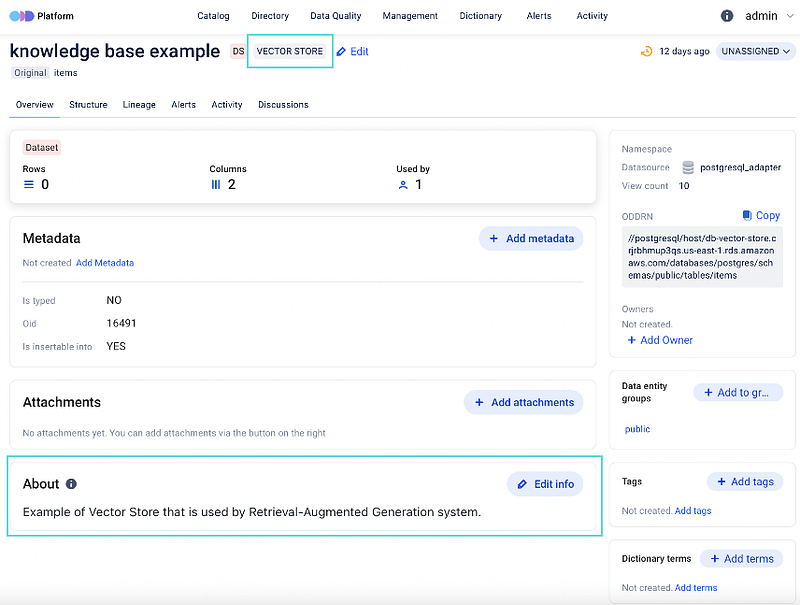
The platform exposes a dedicated dataset type literal — `Vector Store` — that an adapter can emit when the source is a vector-oriented store. Vector Stores show up on Catalog search facets, the [Directory](/features/data-discovery/directory.md), and entity lists, carrying a **`Vector store` type label** and a dedicated value on the **Type** filter facet.
A Vector Store does **not** carry a distinct entity badge. The coloured class badge on a catalog row is keyed by the entity *class*, and `Vector Store` is a *type* within the `Dataset` class — so it shows the same `Dataset` badge as a relational table. The way to tell a Vector Store apart is the type label on the entity and the **Type** facet on [Search](/features/data-discovery/search.md), not the badge colour or icon.
A Vector Store recognised in the ODD catalog
The classification is a strong signal for operators: a Vector Store row in the catalog is the same primitive as a relational dataset (it has fields, owners, tags, lineage edges) but the workload it serves is different (similarity search, retrieval-augmented generation, embeddings storage), and surfacing the type makes it explicit.
## Column data type — `Vector`
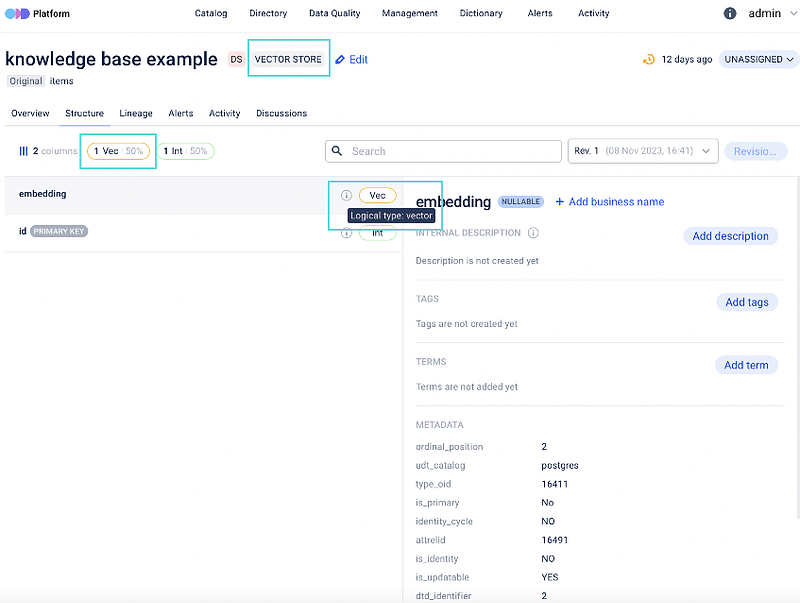
Each column on a dataset carries a data type. The platform's data-type taxonomy includes `Vector` as a recognised primitive — adapters that ingest a column declared as a vector type (e.g., `pgvector`'s `vector(N)` column type) emit it as `Vector` rather than as a generic Array or Unknown type. The Structure tab renders `Vector` columns explicitly, and downstream surfaces (lineage, schema diff, search filtering by data type) recognise them.
A Vector-typed column on a dataset's Structure tab
## Specification source
Both additions — the `Vector Store` dataset type and the `Vector` column data type — are defined in the [opendatadiscovery-specification](https://github.com/opendatadiscovery/opendatadiscovery-specification/blob/main/specification/entities.yaml) repo's `entities.yaml`. Adapters speak the specification and emit either type when applicable; the platform ingests whatever the adapter declares.
## Adapter coverage
The first adapter to surface vector cataloguing was the **PostgreSQL adapter** in [`odd-collector`](/integrations/integrations/odd-collector.md). When the adapter encounters a PostgreSQL table containing at least one column with a `vector` data type (`pgvector` extension), it classifies the table as `Vector Store` during ingestion.
Other adapters that ingest vector-storing systems can emit the same dataset type by following the specification. Coverage grows as more adapters add vector recognition; consult per-adapter pages under [Integrations](/integrations/integrations.md) for the latest matrix.
## Where to next
* [Search and Filtering](/features/data-discovery/search.md) — Vector Stores surface on the Type facet (multi-select on the entity-class tab strip).
* [Data Objects Lineage](/features/data-lineage/data-objects.md) — Vector Stores participate in lineage like any other dataset class.
* [`odd-collector`](/integrations/integrations/odd-collector.md) — the canonical pull collector with the PostgreSQL `pgvector` recognition built in.
* [opendatadiscovery-specification](https://github.com/opendatadiscovery/opendatadiscovery-specification/blob/main/specification/entities.yaml) — the specification source for the `Vector Store` dataset type and the `Vector` column data type.
* [Data Discovery overview](/features/data-discovery.md) — the bucket landing this page sits under.